WETFLAG Calculator – Complete Guide for Paediatric Emergency Use (UK)
WETFLAG
Paediatric resus calculator
Physiological Normals (approx)
How It Works
WETFLAG (APLS Guidelines)
| Initial | Parameter | Formula / Rule | Clinical Note |
|---|---|---|---|
| W | Weight (kg) |
<1y: 0.5 × Mos + 4 1-5y: 2 × Age + 8 6-12y: 3 × Age + 7 |
Foundation for all other calculations. |
| E | Energy (J) | 4 Joules / kg | Shockable rhythms (VF/pVT). |
| T | Tube (ETT) | ID: Age / 4 + 4 (Uncuffed) Depth: Age / 2 + 12 (Oral) |
Reduce ID by 0.5mm if cuffed. |
| F | Fluids | Medical: 20 ml/kg Trauma: 10 ml/kg |
Assess response after each bolus. |
| L | Lorazepam | 0.1 mg / kg | Seizure. Max 4mg. |
| A | Adrenaline | 0.1 ml / kg (1:10,000) | Cardiac Arrest (10mcg/kg). |
| G | Glucose | 2 ml / kg (10% Dextrose) | Hypoglycaemia. |
In paediatric emergency medicine, decisions often need to be made within seconds. Unlike adults, children require carefully adjusted drug doses, airway sizes, and fluid volumes based on body weight.
In many emergency situations, however, a child’s exact weight is unknown or cannot be measured immediately. This is where the WETFLAG system becomes a critical clinical tool.
The WETFLAG calculator is widely used across the UK in emergency departments, ambulance services, paediatric wards, and resuscitation training. It provides a fast, structured method to estimate essential treatment values using age‑based calculations. Its purpose is not to replace clinical judgement, but to support safer, faster, and more consistent decision‑making during high‑pressure situations.
This page provides a complete, clinically accurate explanation of how the WETFLAG calculator works, how to interpret its outputs, and how it fits within UK paediatric emergency care.
What Is WETFLAG?
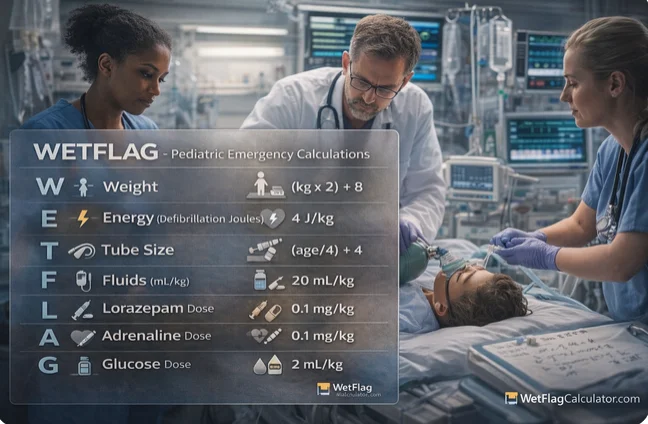
WETFLAG (also written “wet flag” or “WETFLAG paeds”) is a mnemonic used in paediatric (pediatric) emergencies to guide rapid calculations when a child’s weight is unknown. Each letter represents a key clinical parameter required during resuscitation or acute care.
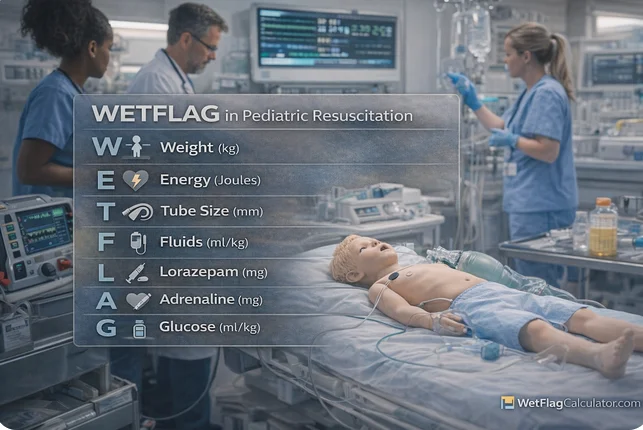
WETFLAG stands for:
- WWeight
- EEnergy (defibrillation)
- TTube size
- FFluids
- LLorazepam
- AAdrenaline
- GGlucose
The system is taught widely in APLS and EPALS courses and is commonly used in UK emergency medicine. Its strength lies in its simplicity: one structured approach that allows clinicians to calculate critical values quickly and safely.
WETFLAG is particularly useful when:
- A child’s actual weight is unknown
- Immediate treatment is required
- Cognitive load is high
- Multiple interventions are occurring simultaneously
Why the WETFLAG Calculator Is Important
Medication and dosing errors are a recognised risk in paediatric emergency care. Unlike adults, paediatric patients require weight‑based dosing for almost every intervention. Under stressful conditions, manual calculations increase the risk of error.
The WETFLAG calculator reduces this risk by:
- Automating calculations
- Presenting values in a clear visual format
- Following standard UK life‑support guidance
- Reducing reliance on memory and mental arithmetic
It is commonly used in scenarios such as cardiac arrest, seizures, sepsis, trauma, hypoglycaemia, and shock. By standardising calculations, it improves patient safety and supports team communication during emergencies.
How the WETFLAG Calculator Works
The calculator is designed to be intuitive and fast, mirroring how clinicians work in real emergencies.
Entering Patient Details
The user enters the child’s age in either years or months. The calculator automatically estimates body weight using established paediatric formulas. This estimated weight becomes the foundation for all subsequent calculations.
The user can also select:
- Medical or trauma context
- Cuffed or uncuffed endotracheal tube
These selections ensure that the displayed values reflect the clinical situation accurately.
Instant Clinical Output
Once the details are entered, the calculator instantly displays all WETFLAG parameters, including weight, drug doses, airway size, and fluid volumes. The layout follows the familiar WETFLAG structure used in training and clinical practice, allowing rapid interpretation even in high‑stress situations.
WETFLAG Formulas at a Glance
These are the formulas and doses behind the calculator, in WETFLAG order.
| Letter | Parameter | Formula or dose |
|---|---|---|
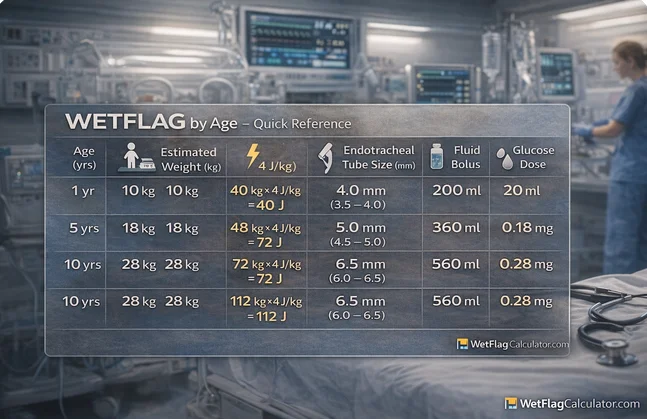
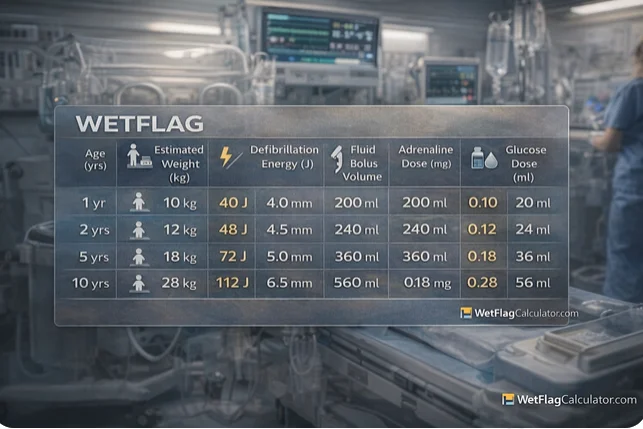
| W | Weight | Under 1 year: (0.5 × age in months) + 4 kg 1–5 years: (2 × age in years) + 8 kg 6–12 years: (3 × age in years) + 7 kg Over 12 years: use measured weight |
| E | Energy | 4 J/kg for a shockable rhythm (VF or pulseless VT) |
| T | Tube size | Age-based, cuffed or uncuffed (shown in the calculator) |
| F | Fluids | 20 ml/kg for medical resuscitation, 10 ml/kg for trauma |
| L | Lorazepam | 0.1 mg/kg, maximum single dose 4 mg |
| A | Adrenaline | 0.1 ml/kg of 1:10,000 (0.01 mg/kg, or 10 mcg/kg) |
| G | Glucose | 2 ml/kg of 10% dextrose |
Use measured weight whenever it is available, and follow local guidelines.
Understanding Each WETFLAG Component
Weight (W)
Weight estimation is the foundation of paediatric emergency care. The calculator uses age‑based formulas recommended in UK life‑support training. These formulas provide a safe approximation when an actual weight is unavailable.
Where possible, an accurately measured weight should always replace an estimate.
Energy (E)
Defibrillation energy is calculated using the standard recommendation of 4 joules per kilogram. This aligns with Resuscitation Council UK guidance for paediatric defibrillation and ensures consistent energy delivery during cardiac arrest.
Tube Size (T)
Correct endotracheal tube sizing is essential for effective ventilation and airway protection. The calculator estimates tube size based on age and adjusts automatically depending on whether a cuffed or uncuffed tube is selected. This helps reduce the risk of airway trauma or inadequate ventilation.
Fluids (F)
For fluid resuscitation, the calculator provides a standard bolus of 20 ml per kilogram. This is commonly used in medical causes of shock and dehydration. Clinical reassessment is required after each bolus to guide further treatment.
Lorazepam (L)
Lorazepam is used in the management of seizures, particularly status epilepticus. The calculator provides a dose of 0.1 mg/kg, supporting timely and accurate treatment while reducing dosing errors.
Adrenaline (A)
Adrenaline dosing errors can have serious consequences. The calculator provides the correct paediatric dose of 0.01 mg/kg (1:10,000) for cardiac arrest, consistent with UK resuscitation guidelines.
Glucose (G)
Hypoglycaemia is a reversible and potentially life‑threatening condition. The calculator provides a glucose dose of 2 ml/kg of 10% dextrose, allowing rapid correction when low blood glucose is suspected or confirmed.
Physiological Reference Values
To support clinical decision‑making, the calculator also displays approximate normal values for heart rate, respiratory rate, and systolic blood pressure. These references help clinicians quickly identify deterioration and assess response to treatment.
Accuracy, Limitations, and Clinical Use
Although WETFLAG is highly useful, it is not without limitations. Age‑based formulas may be less accurate in obese children, infants under one year, or older adolescents. Whenever possible, an actual measured weight should be used.
The calculator should always be used as a clinical support tool, not a replacement for professional judgement, senior input, or local guidelines. Length‑based systems and institutional protocols should take precedence where available.
Use of WETFLAG in UK Clinical Practice
WETFLAG is widely used within UK healthcare and aligns with guidance from recognised authorities such as the Resuscitation Council UK and Advanced Paediatric Life Support (APLS). It is commonly used in:
- Emergency departments
- Pre‑hospital care
- Paediatric wards
- Simulation and training environments
For official guidance, clinicians should refer to national resuscitation and paediatric life support resources provided by recognised professional bodies.
Trust, Safety and Clinical Disclaimer
This calculator is provided as a clinical decision‑support tool only. It does not replace formal medical training, institutional protocols, or senior clinical judgement.
All calculations are based on widely accepted paediatric emergency medicine principles; however, users must always:
- Follow local and national clinical guidelines
- Use measured weight when available
- Escalate care appropriately
- Apply professional judgement in all cases
For authoritative guidance, refer to official UK sources such as the Resuscitation Council and recognised paediatric life support organisations.
Learn More About WETFLAG
Go deeper on any part of the system, from the meaning of each letter to weight estimation and resuscitation use.
 What Is WETFLAG?What each letter stands for and where the mnemonic is used.Open
 WETFLAG by AgeHow a child’s age drives weight, tube and dose estimates.Open
 WETFLAG by ChartA paediatric emergency dosing reference you can scan fast.Open
 WETFLAG in Paediatric ResuscitationClinical use in cardiac arrest, seizures and shock.Open
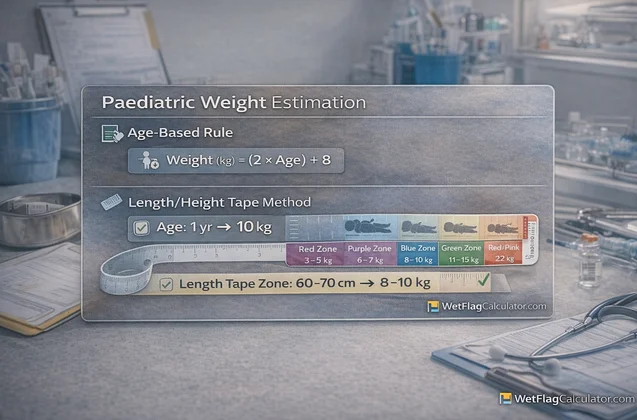 Paediatric Weight EstimationMethods, accuracy and best practice when weight is unknown.Open
Frequently Asked Questions About WETFLAG
Quick answers to the questions clinicians and students search for most about the WETFLAG paediatric emergency calculator.
What does WETFLAG stand for?
WETFLAG is a mnemonic used in paediatric emergency medicine: Weight, Energy (defibrillation), Tube size, Fluids, Lorazepam, Adrenaline and Glucose. It gives clinicians a single, structured way to calculate the key treatment values for a child in an emergency.
What is the WETFLAG calculator used for?
The WETFLAG calculator estimates weight-based drug doses, defibrillation energy, endotracheal tube size and depth, and fluid bolus volumes for a child, usually when the child’s actual weight is unknown and treatment cannot wait for one to be measured. It is used in emergency departments, ambulance services, paediatric wards and resuscitation training across the UK.
Is WETFLAG endorsed by the Resuscitation Council UK or APLS?
WETFLAG is taught as part of APLS (Advanced Paediatric Life Support) and EPALS courses and follows the same age-based formulas used in UK Resuscitation Council guidance. This calculator applies those published formulas; it is a decision-support tool and does not replace your institution’s own protocols or official course materials.
How is a child's weight estimated in WETFLAG?
Standard age-based formulas are used: (0.5 × age in months) + 4 for infants under 1 year, (2 × age in years) + 8 for 1–5 years, and (3 × age in years) + 7 for 6–12 years. Published evidence shows these formulas become unreliable in adolescents over 12, so for that age group the calculator asks for actual measured weight rather than guessing – measured weight should always be used when available, at any age.
What is the WETFLAG defibrillation energy dose?
4 joules per kilogram (J/kg) for a shockable rhythm (VF/pulseless VT), in line with Resuscitation Council UK guidance.
What is the WETFLAG fluid bolus dose?
20 ml/kg for medical resuscitation, or 10 ml/kg for trauma. Response should be assessed after each bolus before giving further fluid.
What is the WETFLAG adrenaline dose for cardiac arrest?
0.1 ml/kg of 1:10,000 adrenaline (equivalent to 0.01 mg/kg, or 10 mcg/kg), given intravenously or intraosseously during cardiac arrest.
What is the WETFLAG Lorazepam dose for seizures?
0.1 mg/kg, up to a maximum single dose of 4 mg, for a child in status epilepticus.
What is the WETFLAG glucose dose for hypoglycaemia?
2 ml/kg of 10% dextrose, given for confirmed or suspected hypoglycaemia during a paediatric emergency.
Is there a WETFLAG app?
There is no separate app to download – the WETFLAG Calculator on this page is a free, mobile-optimised web tool that works in any browser. Most phones let you ‘Add to Home Screen’ from the browser menu, which gives you one-tap access during a shift just like a native app.
Is WETFLAG paediatric the same as WETFLAG pediatric?
Yes. ‘Paediatric’ is the UK/Australian spelling and ‘pediatric’ is the US/Canadian spelling of the same word, and both refer to exactly the same mnemonic and dosing calculator. This page follows UK guidance (Resuscitation Council UK, APLS), but the underlying weight-based approach is used internationally in pediatric emergency medicine.
Can WETFLAG be used for infants under 1 year old?
Yes, WETFLAG includes a specific weight formula for infants under 1 year – (0.5 × age in months) + 4 – and a fixed tube-size estimate for this age group. Estimates are less precise for neonates and preterm infants, so measured weight and local size charts should be used whenever possible.
Is the WETFLAG calculator free to use?
Yes, the WETFLAG Calculator is completely free, requires no sign-up, and works on any device with a web browser.
Final Note
The WETFLAG calculator is designed to support safe, structured, and rapid decision‑making in paediatric emergencies. When used correctly, it reduces cognitive load, improves accuracy, and supports high‑quality patient care.
It should always be used alongside sound clinical judgement, team communication, and established UK guidelines.
Disclaimer: This tool is intended for healthcare professionals only. It does not replace formal medical training, institutional protocols, or clinical judgement.
More Free Converters and Calculators
Beyond WETFLAG, this site has free unit converters for lab results, vitamins and hormones, cooking and everyday measures. Pick a tool, or browse the full series below.
Popular converters
 mmol/L to mg/dLBlood glucose and lab values, both directions.Open
 A1C to Average Blood SugarEstimate average glucose (eAG) from HbA1c.Open
 IU to mgVitamins and hormones, substance by substance.Open
 mL to GramsKitchen conversions based on ingredient density.Open
 Ferritin Unitsng/mL, µg/L, nmol/L and pmol/L in one place.Open
 Insulin UnitsµIU/mL to pmol/L, mIU/L and ng/mL.Open
All converters by topic
WETFLAG and paediatrics
Guides that explain the calculator.
Clinical and lab
Lab values and blood chemistry.
Hormones and vitamins
Unit conversions for common tests and supplements.
Kitchen and cooking
Volume to weight, by ingredient.
Mass and volume
Density-based and everyday volume units.
Everyday units
Quick conversions and calculators.
Browse by series
mL to grams, by ingredient 41
View archive- Agave Syrup
- All-purpose Flour
- Almond Flour
- Almond Milk
- Applesauce
- Banana (mashed)
- Bread Flour
- Brown Sugar (packed)
- Buttermilk
- Cake Flour
- Canola Oil
- Coconut Flour
- Coconut Milk
- Coconut Oil
Show all 41 ingredient guidesShow fewer
- Coconut Sugar
- Corn Syrup
- Cornmeal
- Couscous (uncooked)
- Cream
- Dextrose
- Granulated Sugar
- Honey
- Jelly
- Maple Syrup
- Milk (skimmed)
- Milk (whole)
- Nutella
- Oats
- Olive Oil
- Orange Juice
- Powdered Sugar (unsifted)
- Quinoa (uncooked)
- Rice (uncooked)
- Soy Sauce
- Spinach (fresh, chopped)
- Tomato Paste
- Tomato Sauce
- Vegetable Oil
- Vinegar
- White Sugar
- Whole Wheat Flour
nmol/L to ng/mL conversions 53
View archive- 0.1 nmol/L
- 0.2 nmol/L
- 0.3 nmol/L
- 0.4 nmol/L
- 0.5 nmol/L
- 0.6 nmol/L
- 0.7 nmol/L
- 0.8 nmol/L
- 0.9 nmol/L
- 1.6 nmol/L
- 1.9 nmol/L
- 2 nmol/L
- 2.4 nmol/L
- 10 nmol/L
Show all 53 conversionsShow fewer
- 12 nmol/L
- 13 nmol/L
- 14 nmol/L
- 15 nmol/L
- 17.7 nmol/L
- 20 nmol/L
- 21 nmol/L
- 22 nmol/L
- 23 nmol/L
- 24 nmol/L
- 25 nmol/L
- 25.5 nmol/L
- 26 nmol/L
- 26.3 nmol/L
- 26.7 nmol/L
- 27 nmol/L
- 28 nmol/L
- 29 nmol/L
- 31 nmol/L
- 33 nmol/L
- 34 nmol/L
- 34.9 nmol/L
- 35 nmol/L
- 36 nmol/L
- 37 nmol/L
- 37 nmol/L
- 39 nmol/L
- 100 nmol/L
- 110 nmol/L
- 118 nmol/L
- 120 nmol/L
- 125 nmol/L
- 140 nmol/L
- 150 nmol/L
- 200 nmol/L
- 225 nmol/L
- 250 nmol/L
- 300 nmol/L
- 375 nmol/L