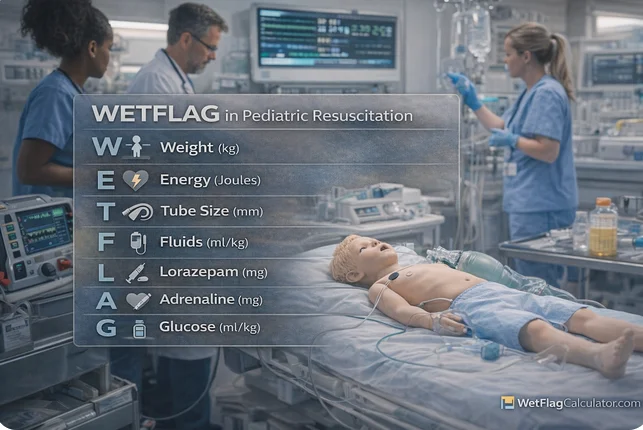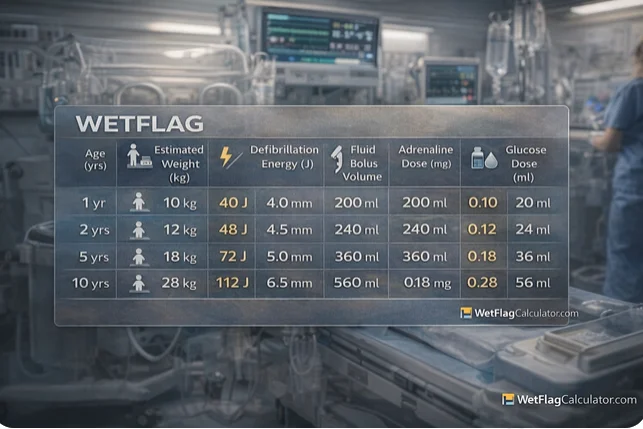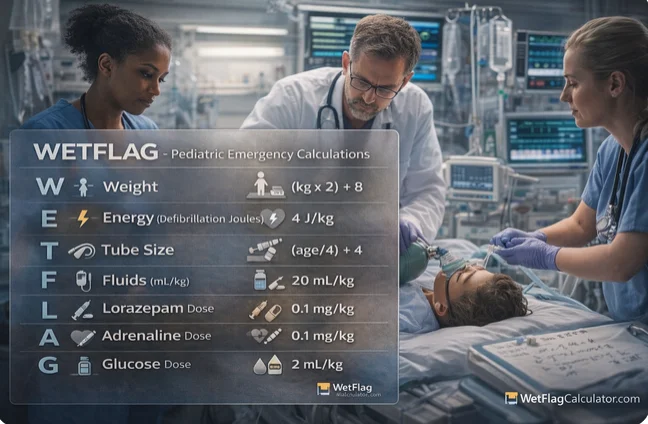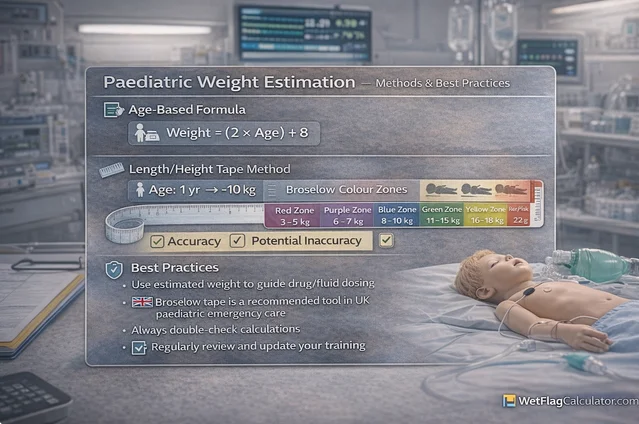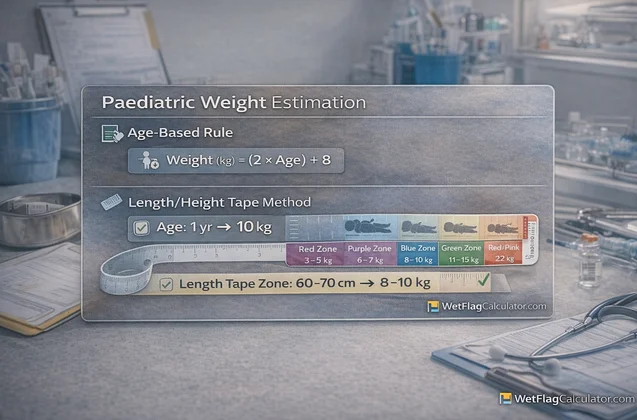
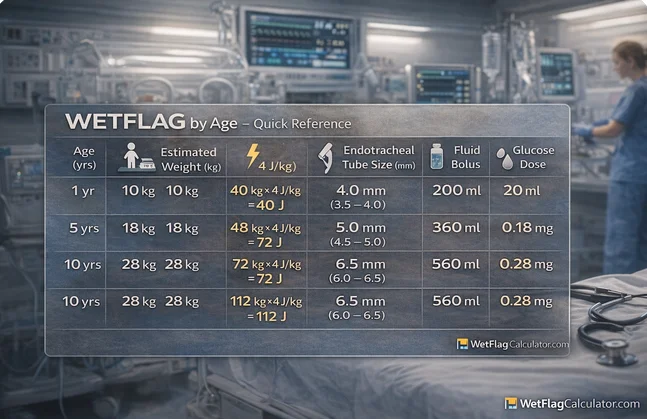
Age plays a central role in paediatric emergency medicine. When a child’s actual weight is unknown, age is often the only immediately available parameter that clinicians can use to estimate drug doses, fluid volumes, and equipment size.
The WETFLAG by age approach explains how age‑based estimation works, why it is used, and what its clinical limitations are. Unlike the WETFLAG chart, which serves as a quick reference, this page focuses on understanding the reasoning behind age‑based calculations.
Why Age Is Used in WETFLAG
In emergency settings, weighing a child may be impractical or unsafe. Age provides a rapid alternative for estimating weight when time is critical.
Age‑based calculations are widely taught in:
- Advanced Paediatric Life Support (APLS)
- Emergency medicine training
- Paediatric resuscitation courses
They offer a balance between speed and accuracy, particularly when no other measurement is available.
How Age Affects WETFLAG Calculations
WETFLAG uses age to estimate weight, which then determines:
- Drug dosages
- Defibrillation energy
- Fluid bolus volumes
- Airway equipment size
As children grow, the relationship between age and weight becomes less predictable. This is why age‑based estimation is most reliable in younger children and less accurate in adolescents.
Accuracy of Age‑Based Estimation
Age‑based formulas provide a useful approximation but are not perfect. Studies show that:
- They may underestimate weight in overweight children
- They may overestimate weight in undernourished children
- Accuracy decreases with increasing age
For this reason, age‑based estimation should always be viewed as a temporary solution until a measured weight is available.
Clinical Implications
Understanding how age influences WETFLAG calculations helps clinicians:
- Recognise potential dosing errors
- Adjust treatment based on patient appearance
- Decide when alternative methods are required
- Improve overall patient safety
This knowledge is particularly important during resuscitation, where decisions must be made rapidly and confidently.
Age vs Weight: When to Use Each
| Scenario | Recommended Method |
|---|---|
| Weight known | Use actual weight |
| Emergency, no scale | Use WETFLAG age estimation |
| Obese child | Use caution, reassess frequently |
| Stable patient | Measure weight as soon as possible |
Relationship to the WETFLAG Chart
The WETFLAG chart provides a visual reference for age‑based values, while this page explains the reasoning behind those values.
For quick reference, see the full chart
When Not to Rely on Age Alone
Age‑based estimation should be avoided or used with caution in:
- Neonates
- Adolescents
- Children with obesity
- Chronic illness affecting growth
In these cases, alternative methods or measured weight should be prioritised.
Clinical Best Practice
To use age‑based WETFLAG calculations safely:
- Treat values as estimates
- Reassess frequently
- Confirm with measured weight
- Follow local protocols
- Use clinical judgement at all times
Conclusion
WETFLAG by age provides a practical framework for emergency care when weight is unknown. Understanding its strengths and limitations allows clinicians to apply it safely and effectively.
When combined with clinical judgement, structured tools, and national guidance, age‑based estimation remains an important part of paediatric emergency medicine.
Disclaimer: This content is for educational purposes only and does not replace clinical judgement, local policy, or formal medical training.