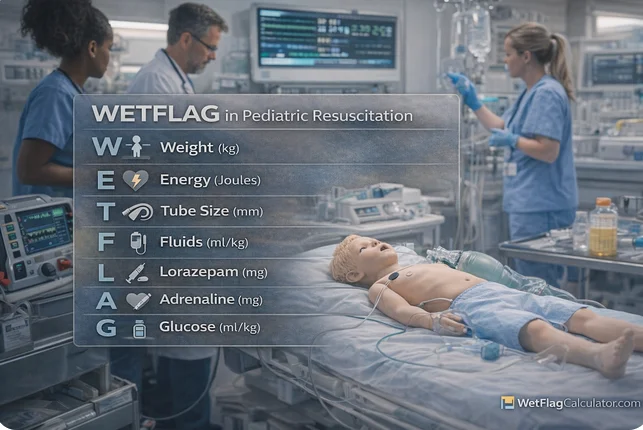
In paediatric emergencies, rapid access to accurate information is essential. When a child’s weight is unknown and decisions must be made immediately, clinicians rely on structured reference tools rather than complex calculations. The WETFLAG by chart approach provides a clear, visual method for estimating key treatment values during resuscitation.
Unlike explanatory articles or calculators, the WETFLAG chart is designed for quick reference. It allows clinicians to scan, confirm, and act without delay, making it especially useful in emergency departments, ambulances, and resuscitation bays.
What Is the WETFLAG Chart?
The WETFLAG chart is a tabulated version of the WETFLAG system. It presents age‑based estimates for the most critical parameters used in paediatric emergency care, including:
- Estimated body weight
- Defibrillation energy
- Endotracheal tube size
- Fluid bolus volume
- Adrenaline dose
- Glucose dose
The chart is designed to support rapid decision‑making when time, staff, or resources are limited.
When to Use a WETFLAG Chart
The WETFLAG chart is commonly used when:
- A child’s weight is unknown
- Immediate resuscitation is required
- Mental calculations may increase error
- A quick visual reference is needed
- Multiple team members require the same information
It is particularly useful in:
- Cardiac arrest
- Status epilepticus
- Septic shock
- Trauma resuscitation
- Pre‑hospital care
WETFLAG Chart (Paediatric Reference Table)
⚠️ Important: Values are estimates only. Always confirm with measured weight and local clinical guidelines when possible.
| Age | Weight (kg) | Energy (J) | Tube Size (mm) | Fluids (ml) | Adrenaline (mg) | Glucose (ml) |
|---|---|---|---|---|---|---|
| 1 yr | 10 | 40 | 4.0 | 200 | 0.10 | 20 |
| 2 yrs | 12 | 48 | 4.5 | 240 | 0.12 | 24 |
| 3 yrs | 14 | 56 | 4.5 | 280 | 0.14 | 28 |
| 4 yrs | 16 | 64 | 5.0 | 320 | 0.16 | 32 |
| 5 yrs | 18 | 72 | 5.0 | 360 | 0.18 | 36 |
| 6 yrs | 20 | 80 | 5.5 | 400 | 0.20 | 40 |
| 7 yrs | 22 | 88 | 5.5 | 440 | 0.22 | 44 |
| 8 yrs | 24 | 96 | 6.0 | 480 | 0.24 | 48 |
| 9 yrs | 26 | 104 | 6.0 | 520 | 0.26 | 52 |
| 10 yrs | 28 | 112 | 6.5 | 560 | 0.28 | 56 |
| 11 yrs | 30 | 120 | 6.5 | 600 | 0.30 | 60 |
| 12 yrs | 32 | 128 | 7.0 | 640 | 0.32 | 64 |
How to Use the WETFLAG Chart Safely
- Identify the child’s age
- Locate the corresponding row
- Use values as an initial guide
- Apply clinical judgement
- Replace estimates with measured values as soon as possible
The chart is intended to support decision‑making, not replace professional judgement.
Clinical Interpretation of Values
Weight
Estimated using age‑based formulas commonly taught in paediatric life support.
Defibrillation Energy
Calculated at 4 joules per kilogram, consistent with UK resuscitation guidance.
Tube Size
Approximate internal diameter for uncuffed tubes. Adjust based on anatomy and clinical assessment.
Fluids
Standard bolus of 20 ml/kg, commonly used in shock and dehydration.
Adrenaline
Dose shown is for cardiac arrest (1:10,000 concentration).
Glucose
Based on 10% dextrose at 2 ml/kg for hypoglycaemia.
Advantages of Using a WETFLAG Chart
- Fast and easy reference
- Reduces calculation errors
- Improves team communication
- Suitable for high‑stress environments
- Useful for training and simulation
Limitations of the WETFLAG Chart
- Less accurate in obese children
- Not suitable for neonates
- Does not account for individual variation
- Should not override clinical judgement
Whenever possible, measured weight and local protocols should be followed.
Digital WETFLAG Tools
For dynamic calculations and automatic updates, clinicians can use a digital version of the WETFLAG system:
Digital tools reduce manual error and are particularly useful in fast‑paced clinical environments.
Frequently Asked Questions
Is the WETFLAG chart accurate?
It provides safe estimates but should always be confirmed with measured values when possible.
Can this chart be used in trauma cases?
Yes, but fluid and drug dosing must be reassessed frequently.
Should this chart replace clinical judgement?
No. It is a support tool, not a substitute for clinical decision‑making.
Final Notes
The WETFLAG chart is a practical, widely used reference that supports rapid and consistent decision‑making in paediatric emergencies. When used correctly, it enhances safety, reduces errors, and improves team performance during critical situations.
Disclaimer: This content is for educational purposes only and does not replace professional medical judgement, institutional protocols, or formal training.